
Portfolio GMV
$0b+
We diagnose growth constraints, then we fix them. Account structure, creative, measurement. The three things that decide whether scale is real or imagined. Every position we hold is published openly.


"The real key was the transparency. They feel like they're part of your organisation."
"One of the strongest performance agencies I've worked with. Depth of Meta platform expertise, creative strategy, and data-led approach genuinely sets them apart."
"Fabulous as far as strategic focus and insights across the board. Highly recommend their team. Ibra has been instrumental in driving change in our business."

A creative problem. A measurement problem. A margin problem. Or a structural problem in the account. We diagnose all three lenses before we touch a budget.
Test whether segmentation is useful versus excessive, whether budget is concentrated enough to produce a clear read, and whether the account can scale without breaking.
Under modern Meta, creative does the targeting. Volume alone is not enough. Real growth comes from genuine conceptual diversity across persona, angle, offer and format.
Judge channels by acquisition MER, not blended. Reporting is meant to change decisions, not validate them.
Where is your next dollar actually going to produce profitable growth? Not an audit. A structured review of how paid media, data and unit economics interact. Used internally by founders, finance and marketing to make major decisions, whether we work together or not.
Book a call →Run by a senior strategist. Reviewed by senior leadership. Built on the same workflow we use with active clients.
Long-form on YouTube. Tactical on the podcast. Sharp takes in writing. If we believe it, you can find it.
If every ad you launch is a minor variation of the same idea, the platform cannot tell you anything you do not already know. Here is how we structure concept-level testing.
The positioning argument for why the "agency" label undersells the work, and how we frame the business instead.
Blended MER hides whether new-customer economics are healthy. Returning customer revenue distorts the read. Why we separate them, and which number to actually use.
Anonymised audit walkthrough. A fast-fashion account harvesting demand it never created, with no testing structure and the read inflated on top.
The long-form version of how we think: account structure, creative strategy, measurement and the unit economics behind every scaling call. New uploads most weeks.
Three engagements from the portfolio, in full. Every number was published with the client's permission and reported as it happened, not directionally.
Fashion · AU + US + UK + EUThe real key was the transparency. They feel like they're part of your organisation. You trust people on the other side who have a real interest in seeing your business succeed, not their own returns.
Fashion · 90 daysWe rebuilt the account around new-customer acquisition, not blended return. Concentrated the testing budget, fixed the structure, and let it do the work. Doubled new-customer growth and a 79% Meta lift followed inside the first 90 days.
Wine DTCOne of the strongest performance agencies I've worked with. Depth of Meta platform expertise, creative strategy and data-led approach genuinely sets them apart.
MetaDirect-to-expert. No account executive layers. Senior operators run your account, supported by the co-founders who built the methodology.

Owns client service across the agency, setting the standard every pod is held to and developing the leaders who run them. Background in scaling teams and developing the operators behind 7 to 9-figure brands.

Leads product, measurement and the in-house software stack. Writes and speaks publicly on incrementality, creative strategy and account structure.

Leads a pod across Meta, Google and TikTok, spanning performance marketing and growth strategy. Has taken accounts to record-revenue months and built deep trusted-advisor relationships.

Leads a pod across Meta, Google and TikTok, spanning performance marketing and growth strategy. Specialises in scaling high-spend brands, heritage labels and fast-growth names, and launching into new markets.

Owns growth strategy across the portfolio: the experimentation, incrementality testing and measurement rigour behind how accounts scale. Sets the technical standard the strategist team is trained to, with a focus on complex, omnichannel brands.

Leads creative strategy across the portfolio, turning audience insight into the concepts and angles that drive profit. Distils what wins into frameworks the whole team can run, so creative performance compounds across accounts instead of being re-solved on each.

Leads new business and partnerships: how the firm itself grows. Brings the same commercial lens to the firm's growth that the team brings to client accounts.
We run paid media for 8 and 9-figure eCommerce brands across Meta, Google, TikTok and Pinterest. The job is new-customer acquisition that holds up against the P&L, not platform-reported ROAS.
Our core metric is 30-day LTGP to CAC: gross profit from the first purchase divided by acquisition cost. We judge acquisition on acquisition MER, not blended, because returning-customer revenue distorts the read. Platform ROAS on its own is not enough.
Mostly consumer and retail brands at meaningful scale, often 8 and 9 figures, across fashion, beauty, CPG and supplements. As a rule, we only run audits for brands doing over $5 million a year in revenue. The common thread is that measurement and commercial decisioning genuinely matter to them.
Both, and usually the measurement first. Most brands that think they have a platform problem actually have a creative, margin, offer or tracking problem. We diagnose the real constraint before we touch budget.
With a free strategy session and audit. It is free, and most brands use the output internally to align founders, finance and marketing before making major decisions.
The free strategy session and audit is fast and free. Most brands use the output internally to align founders, finance and marketing before making major decisions.
Book a call →This is the working version of our worldview. It is the same document our team uses to make decisions inside client accounts, written for operators who would rather understand the model than be sold to. Every position below is testable, falsifiable, and applied.
The default story is that the platform stopped working. The reality is usually somewhere else: creative is too similar to differentiate, measurement is crediting the wrong levers, margins cannot absorb the spend ladder, the offer is not strong enough, or the account is built to hoard signal rather than learn from it. The first move on any engagement is finding the real constraint, then sequencing the work to remove it. Everything else is noise.
Meta and Google work. They are noisy, biased, and credit themselves generously, but they work. If platform performance moves and the business does not, the problem is upstream.
The wrong constraint gets a confident answer. Spend goes up, creative goes up, segmentation goes up. The number does not move. Then "Meta is broken" enters the conversation.
Diagnose first, sequence second, spend third. Almost every decline we have inherited was a diagnosis that never happened, dressed as activity that did.
The same three diagnostics, every engagement, in the same order. Each lens has its own failure modes. Each one breaks differently. Each one needs a different fix.
Test whether segmentation is useful or excessive. Whether budget is concentrated enough to produce a readable signal. Whether the account is built so the system can actually decide what is working.
Under modern Meta, creative does the targeting. Volume alone is not enough. Real growth comes from genuine conceptual diversity across persona, angle, offer and format. Variations of one of those four are not concepts.
Judge channels by acquisition MER, not blended. Use incrementality, not attribution, as the upper bound. Reporting is meant to change decisions, not validate them.
Gross profit from the first purchase within 30 days divided by customer acquisition cost. It reconciles with the P&L, it cuts through platform credit games, and it gives a clear read on whether acquisition is healthy in absolute terms, not just better than last week.
First-order economics are negative. Spend is borrowing against an LTV assumption that may not arrive. Usually a margin or offer problem, not a media problem.
Marginally profitable on first order, but constrained. Either pricing, creative, or account structure is leaving room. Investigate the constraint before scaling spend.
The right place for most acquisition-led brands. Profitable on first order with room to invest in growth. The goal is to stay here while spend climbs.
Acquisition is over-efficient, which usually means money is being left on the table. The brand could absorb more spend without breaking the economics.
Returning customer revenue distorts the read on whether acquisition is doing its job. Separate them at the source, judge each on its own.
1-day view attribution inflates Meta credit by 20–40% in most accounts. Use it as a sanity check, not as the optimisation signal.
Geo-lift and in-platform incrementality tests bound what the platform can legitimately claim. Where it disagrees with reality, reality wins.
A concept is a combination of four variables: persona, angle, offer, format. Change one of those and you have a new concept. Change the headline or the colour of a button and you have an iteration. Most accounts are testing iterations and calling it creative testing. The delta in performance lives at the concept level, not below it.
The customer segment you are addressing. Founder vs operator. New buyer vs returning. Frustrated vs aspirational. Each persona forces a different angle, offer, and format combination.
The reason this product, for this person, at this time. Pain point. Mechanism. Status. Identity. The angle is what you are actually trying to convince someone of, before you ask them to buy.
What they get and on what terms. Bundle, discount, trial, financing, risk reversal. The offer is the variable most brands under-invest in, and the one that most often unlocks new spend ceilings.
Talking head, UGC, listicle, static, animation, brand film. Format is a concept variable, not a production decision. Different formats serve different angles. Testing format diversity is testing concept diversity.
Most accounts are over-segmented to the point where nothing is readable. Split budget across too many ad sets on Meta, or too many campaigns and asset groups on Google, and every call is made on noise, with too few conversions behind any one of them to tell signal from variance. This is not about chasing a learning phase. It is about giving each platform's system enough concentration to allocate budget well, and giving you enough signal to draw clean conclusions about what is actually working.
The point of the account is to teach the system, and us, what works. Excess segmentation buys precision that the data cannot support. Consolidate until each meaningful decision has enough signal behind it to be confident.
Meta, Google & TikTok all distribute budget better than manual management once they have volume, but they will spend into brand and existing demand and credit-grab if you let them. Concentrate spend, but fence the automation: separate brand from non-brand, new customers from existing, and read true incremental acquisition.
There are cases where segmentation is justified. Geo, language, product line with materially different economics, audience with a different commercial value. These are decisions, not defaults. Most are defaults.
Four mental models that sit underneath the lenses, the metrics, and the frameworks. We come back to these whenever the work gets noisy.
The free strategy session and audit applies this method to your account. Used by founders, finance, and marketing to make better decisions whether we work together or not.
Book a call →We do not segment our work by platform or by tactic. We work by the lever that actually moves profit. The five disciplines operate as one engagement, run on tooling we built in-house.
Most brands diagnose the wrong problem. The result is a platform fix for what is actually a margin, measurement, or product problem. We start by finding the real growth constraint, then we sequence the work to remove it.

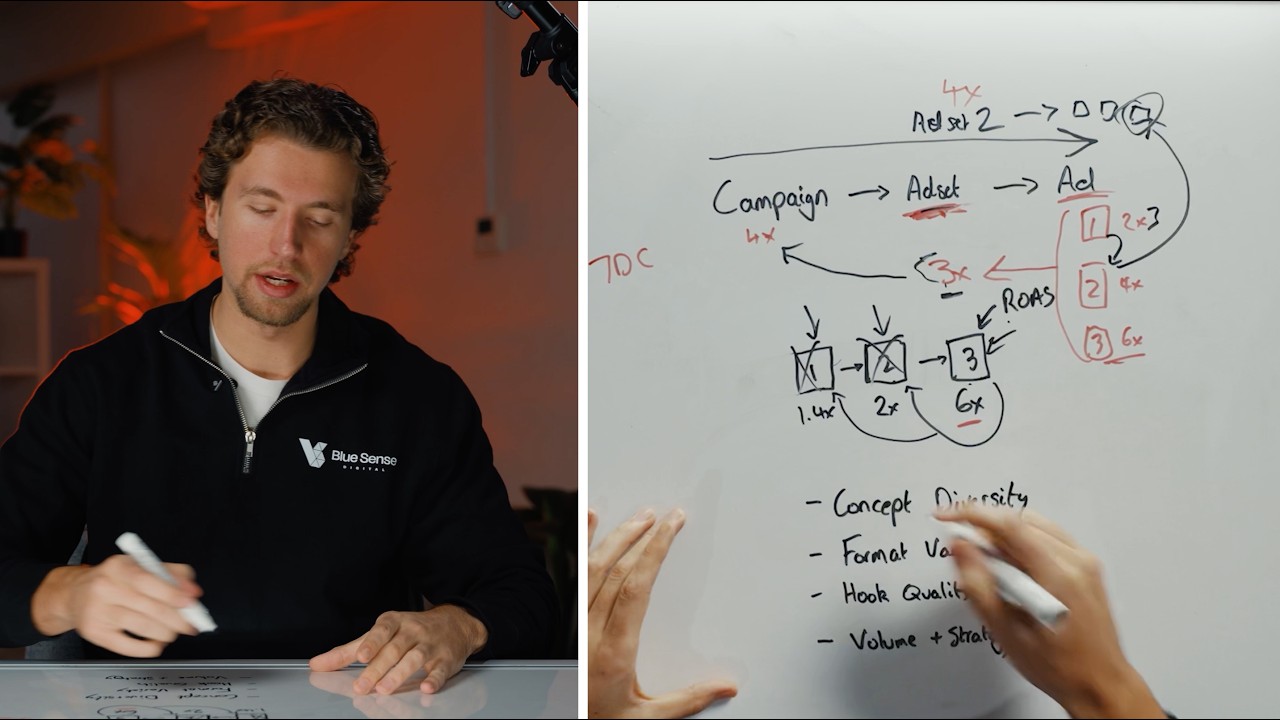
Most creative testing produces no learning because the variations are too similar to differentiate. We build a concept-level testing structure so each test changes a meaningful variable, and the account compounds insight over time, not just spend.
An ad account looks good in isolation only when the P&L is ignored. We bring unit economics into the same room as the media plan so spend decisions reflect what the business can actually absorb, and what it should be aiming for.

 Meta Ads
 Google Ads
 TikTok Ads
Account structure decides what the system can learn. We concentrate budget so the system can allocate it well and so performance stays readable, optimise to signals that reflect causality, and run incrementality tests so spend reflects what is actually moving the business, not what the platform credits itself.
Most accounts optimise off what the platform credits itself, which is not the same as what actually moved the business. Geo-holdout experimentation, causal impact modelling, and our proprietary commuting zone approach close the gap between credited revenue and real lift. For omni-channel brands, we extend the same discipline into retail sales and foot traffic.
We do not run accounts off platform dashboards alone. We built our own analytics platform so geo-lift incrementality, causal impact, and accurate financial forecasting are part of the operating cadence, not a quarterly project. Reporting refreshes hourly across finance, customer, platform, and business-level metrics, so the team and the client are always working off the same number.
Run holdout and geo-lift tests as the upper bound on attribution claims. We size the cells, model the causal impact, and report what spend actually drove what revenue.
Forecast revenue, contribution margin, and payback at the spend ladder we are recommending. Used to align finance, founders, and marketing on the same number.
Finance metrics, customer metrics, platform metrics, business metrics. All refreshed continuously, all reconciled, all in one place. No spreadsheets, no exports.
BSD Index gives you ranges from across the client base by vertical and spend band, so you can see whether your metric is healthy in absolute terms or just better than last week.
// Internal analytics platform · Built and maintained in-house
The free strategy session and audit is a structured diagnostic across the six capabilities. Used by founders, finance, and marketing to make better decisions, whether we work together or not.
Book a call →Long-form on YouTube. Tactical on the podcast. Sharp takes in writing. Audit walkthroughs anonymised. If we believe it about paid media, eCommerce finance, or creative strategy, you can find it here.
Tactical and strategic content on paid media, creative, measurement, and scaling eCommerce. The same thinking we apply to client work.
Daily short-form on measurement, creative testing, scaling decisions, and the things most operators get wrong.
Long-form interviews and internal team episodes on what is actually happening inside high-scale DTC and retail businesses. Hosted by Scott Wilkinson.
Scott on the positioning argument for why the "agency" label undersells the work, and how BSD frames the business instead.
Practical guardrails for using AI in ad creative without eroding brand credibility or audience trust signals.
Aaron Luxmoore on feeding first-party customer data into paid media decisions instead of optimising on platform signals.
The reasoning for moving off the percentage-of-spend pricing model and what we replaced it with.
Whether ChatGPT-native ads are a real channel for eCommerce or noise operators can ignore for now.
How over-running paid spend against existing customers destroys retention contribution margin and distorts MER.
Sharp takes, frameworks, and arguments. Written to be useful inside operator-led teams.
Blended MER hides whether new-customer economics are healthy. Returning customer revenue distorts the read. Why we separate them, and which number to actually use.
Why most creative testing produces no learning, and what a real concept-level test looks like in a real Meta account.
Most accounts are over-segmented to the point where nothing is readable. Here is the math, and here is the fix.
The single commercial metric we judge acquisition against. What it actually means, the ranges, and how to use it to make better spend decisions.
Platform ROAS is a credit metric, not a profit metric. How to swap the optimisation target without losing scale.
What gets a brand from $5M to $20M is not what gets it from $50M to $100M. A short framework for spotting the next constraint.
The same diagnostic structure we apply to every engagement, with client names removed and metrics directionally preserved. Read as much for the method as for the findings.
An activewear brand's 30-day LTGP:CAC had slid from 1.78 to 1.42 with recent months under 1.0, while a near-5x reported ROAS masked a lift test that came back at 0.72 incremental.
A fast-fashion brand ran almost all of its budget in catalogue ads with no testing engine, LTGP:CAC compressed under 1, and spend concentrated in the top 1% of ads.
1-day view attribution was masking a near break-even acquisition account and steering budget into the weakest region.
Meta reported a 12.5 ROAS while true acquisition MER sat at 1.68, half the budget bled to existing customers, and first-order economics were below breakeven.
A fashion accessories brand fragmented a modest Google budget across 29 campaigns and let a target-ROAS setting throttle the new-customer volume it needed most.
A B2B equipment retailer ran 10.8 reported ROAS against 6.6 incremental, with over half of Meta spend hitting existing customers and cold prospecting losing money.
A fast-growing outdoor brand was serving home-currency product feeds into every offshore market, suppressing Shopping before any geo expansion could work.
Profitable on first purchase with tight measurement, but spending US-scale dollars into a small market with testing underweighted and frequency climbing past six.
The free strategy session and audit applies the same diagnostic to your account. Used by founders and CFOs to make better decisions whether we work together or not.
Book a call →Every case study below is published with the client's name and the actual outcome. We report on what changed in the business, not what changed in the dashboard. Selected case studies from the 60 brands in the portfolio.
Four engagements from the portfolio. Every number was published with the client's permission and reported as it happened, not directionally.
Fashion · AU + US + UK + EUThe real key was the transparency. They feel like they're part of your organisation. You trust people on the other side who have a real interest in seeing your business succeed, not their own returns.
Fashion · 90 daysWe rebuilt the account around new-customer acquisition, not blended return. Concentrated the testing budget, fixed the structure, and let it do the work. Doubled new-customer growth and a 79% Meta lift followed inside the first 90 days.
Wine DTCOne of the strongest performance agencies I've worked with. Depth of Meta platform expertise, creative strategy and data-led approach genuinely sets them apart.
MetaWe pointed the account at contribution profit, not credited revenue. CAC fell 40% and the saved margin dropped straight to the bottom line, capped by a record end-of-financial-year.
The free strategy session and audit walks the same diagnostic across your account that we used on every case study above. Used by founders and CFOs to make better decisions whether we work together or not.
Book a call →We hire commercially-minded people who want exposure to high-scale DTC and retail brands, real ownership of outcomes, and the technical depth to make decisions that actually move the business. Global remote, APAC-friendly hours.
Produce the best financial outcomes in consumer brand paid media, and prove it in public. Attract, develop, and empower exceptional people who align with our values and crave a meaningful challenge.
We assume complete responsibility for nearby outcomes. The work is not done until the client outcome is real, the dashboard reconciles with the P&L, and the next constraint is identified.
We work with humility towards excellence, as students and educators. We test our positions in public, change them when the data demands it, and prefer being correct to being consistent.
We care about creating extraordinary interactions with clients and teammates. Standards are high. Care is higher. People who make this place better are the ones we build the company around.
Once a year the whole team flies out together. Strategy, but also the city tour, the winery day, the cooking challenge, the safari. The work matters and so do the people doing it.


// Annual global team retreat · Funded by the company · Spouses welcome on selected days
The full Blue Sense team across strategy, media buying, creative and growth.


Five live roles. All full-time. All global remote with APAC-friendly working hours. Apply links go to the role brief or application form.
A P&L-level growth operator role, not a channel-isolated media buyer. Forecasting, FP&A and data science exposure across high-scale DTC and retail brands. You run growth strategy, not just an ad account.
Apply for this role →A commercially-minded creative role focused on producing concepts that move spend, not assets that fill a calendar. You build the creative brief, drive concept-level testing, and own the creative engine inside high-scale brands.
Apply for this role →A commercially-minded video editor focused on growth-driving creative, not portfolio reels. You take strong concepts and turn them into ads that test well, scale well, and survive the algorithm.
Apply for this role →A designer who treats creative as a scalable revenue engine, not a brand exercise. You produce static, motion, and offer-led concepts that perform at the spend levels we run.
Apply for this role →The operational backbone of how the agency executes at scale. You own the systems, the QA, the launch cadence, and the documentation that lets strategists and creatives move fast without breaking accounts.
Apply for this role →Training, working life, impact, career. The four areas we built the company around. None of this is theoretical. Every benefit below applies on day one.
We hire ahead of growth where the person is right. If you are a commercially-minded operator who wants real exposure to the P&L, send us a note.
Email hire@bluesensedigital.com.au →We have your details. Choose a slot below and we will confirm by email within one business day. $5M+ brands only.